Showing posts with label farm. Show all posts

Monday, December 3, 2012

Professional Agriculture Skills

The professional agriculture skills class at ASYV was a pleasure to teach this year.  There are three professional skills programs at ASYV: modern agriculture, IT and hospitality.  The professional skills programs all started this year.  The idea is to give the students some hands-on, employable skills other than their high school education.
Senior 5 students preparing their plots for planting

I helped to develop the curriculum for the agriculture professional skills with Gervais, the village agronomist.  However, I only started teaching in second term.  I split the teaching half and half with Gervais. Both senior 6 (grade 12) and senior 5 (grade 11) took the class this year.  The class was four hours every week for each grade.  It was broken up into two days (with two hours of instruction each day).  Senior 6 finished their professional skills at the end of second term, so I had less time with them.

Some of my favourite people were with me in professional skills program.  I can honestly say that these students are models of the ASYV core values (integrity, respect, role model, learning community, commitment, support and interest of the child) and they will go far!

Mulching the plots
I tried to make the classes as interactive and hands on as possible.  The students take these classes after lunch, after being in school from 7am until 2pm.  I know that Rwandans have an amazing amount of patience and ability to sit still and listen- but there's no need to bore them with lectures after being in school all day. We covered many of my favourite topics like permaculture, agroforetry, seed saving, nursery care, compost, swales, irrigation, greenhouses etc.

Planting seeds in their plots
The following are some pictures from the year.  I didn't bring my camera to all the classes so it's just a small sample of the year.

The first field trip to an agricultural fair near Kigali.
Learning about different cultivars of sorghum

Admiring the giant cassava roots

What? You made this out of poo?  Humanure compost booth

Part of the group at the fair

Learning about greenhouses and drip irrigation systems.

Learning about the properties of greenhouses
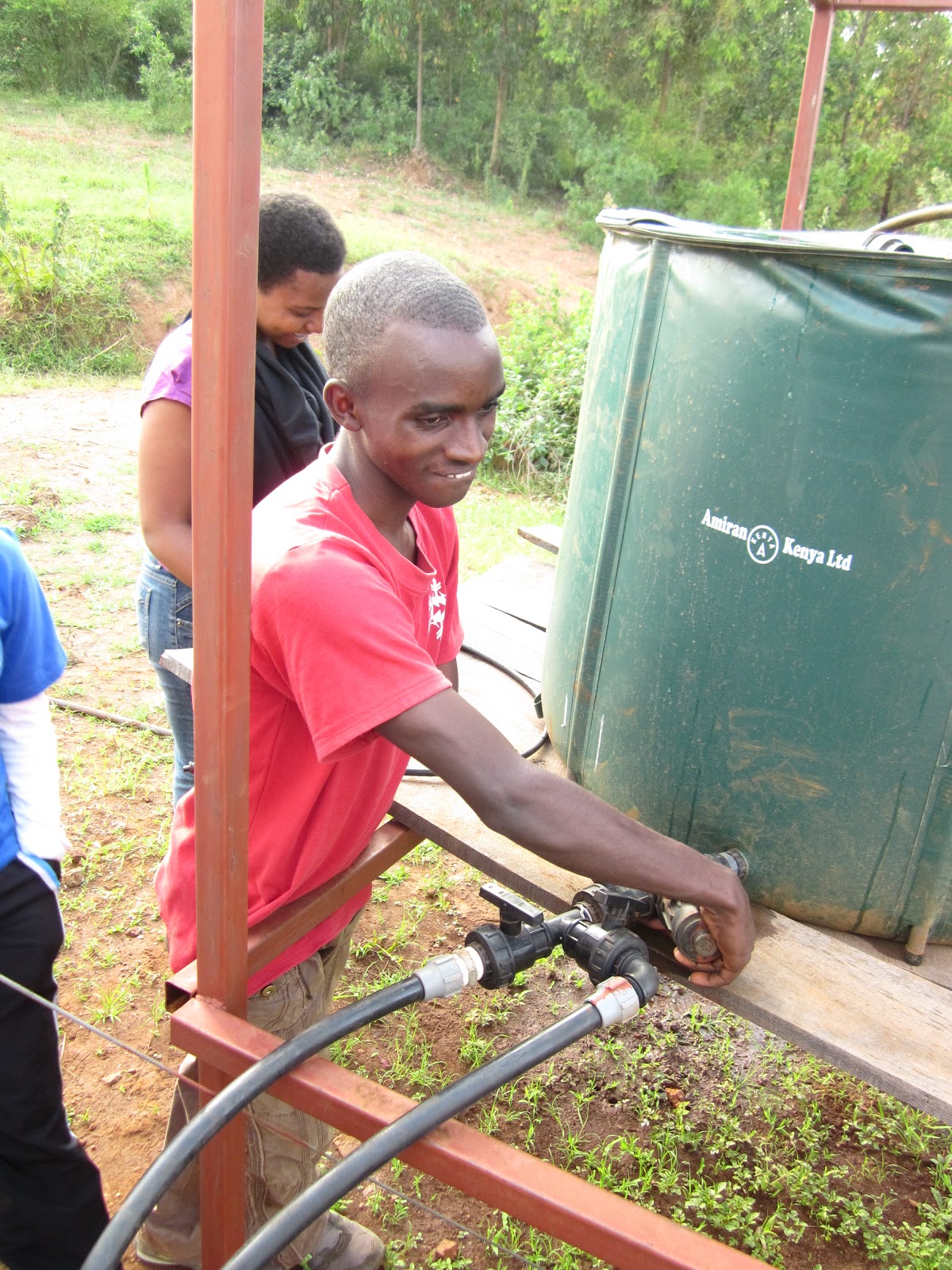
Hooking up the irrigation to the rain water tank

Multi level learning


Setting up the drip irrigation

Setting up the drip irrigation


More pictures from ASYV learning how to use an A-frame to mark out a swale.

Add caption


The second field trip was to Sina Gerard's agri-business in Nyirangarama.  His business is located half way between Kigali and Musanze, the headquaters to all mountain gorilla activities.  Pretty much every bus stops there to take a break for the 3 hour drive.  This is one of those successfully business models where he started small, making bread, with one employee and now has over 400 employees, with many value added products like bread, jams, fruit juice, chilli sauce, meat, banana wine, banana beer, etc.  He also has built an elementry and high school for the community and a carpentry school. His most famous products are juice concentrates and a chili sauce.  He started making these value added products and getting the farmers around him to grow these products for him to process.  He has many other products but one of the interesting things you will see in these next pictures is that he tries new things.  Many farmers in Rwanda grow the same thing as their neighbours- and for good reason, they mostly grow staple crops that they and their community will consume.  However, if you are trying to make a business out of it- it is a good idea to try new things, to find the niche market.
Senoir 5+6 and staff on a tour of some of Gerard's demonstration farms

What?!! Strawberries in Rwanda!  It's true- but only here in the misty mountains of Nyirangarama 
Taking notes on strawberry farming

Strawberries, apple trees and agroforestry species in demo farm

Grapes and pineapples together.! Yes it's true

Check out those apples!

Cows and students

Friday, April 20, 2012

Happy Travels

The end of term here was very busy and I seem to have developed an allergy to my computer.  Farmer's are not known for their love of technology, some are pretty much techno-phobes.  I'm not sure what the problem is... slow internet, so many other things to do, writers block, but when I look at the computer I say 'achoo' I don't want to go near that thing!

However, we have just spent two weeks in Uganda and Kenya.  So here is a bit of a photo essay of the experience.
Byoona Amarga, Lake Bunyoni, Uganda. solar powered, composting toilets, library, good food,  lake side setting of tranquility!  I would head back there if Uganda visas weren't such a rip off!
 
Hell's Gate National Park, Kenya.  Maybe the only park in East Africa where you don't have to be in a truck while watching animals.  Rent bikes or walk on a DIY safari!

 
Notice Jack meandering quietly beside the African Buffalo- while I booted my way past them...I think I would take a bear over a buffalo any day.  They seem little unpredictable and daft in a dangerous way.  And they give a mean stink eye.


Zebras!  They make crazy alien/dog noises. for real.  Also Hell's gate has some sweet camping on the rocks above all the plains where the animals are grazing.


One of the most inspiring parts of the trip was visiting JB on his farm Balitah Ravens Farm in Butula District, Kenya.  This man is a permaculture evangelist! No really- preacher turned permaculturalist.
JB and part of his family

I was connected to him by Salt Spring's Michael Nichols of Seven Ravens Farm. Both Michael and JB have been doing permaculture work in primary schools in the area. The permaculture projects are to develop food, shade, timber, trees, funds and training for these primary schools.  They are amazing projects.  I plan to write a more in depth blog post on them soon.
Fish pond at Bukati Primary school with a forest around it to create a cooler microclimate.  Rain water is harvested to feed this pond and the fish are harvested to feed the children.

The visit with JB really got a kick in my rear end to bring permaculture to Rwanda.  It's happening in Kenya- why not Rwanda, why not ASYV?  It seems like I will have to work hard to 'sensitize' the farm staff and admin to this idea. (Sensitization is a special East African English word which means to tell someone about an idea or a plan.  Sensitization can be very frustration to someone of North American culture because they ask: 'why do we have to talk about this so much?  can't we just do it?'  But you can't do anything here without sensitization.)

JB and students working on the permaculture project at Buduma Primary School, Kenya
The programmer who planted trees
Needless to say when I got back to ASYV this week I have been working hard at my garden around my house. I was happy to see that the rains in Rwanda over the two weeks we were away made the garden grow very well. This is a little organic garden/permaculture seed that I hope will start spreading around the village.  The farm at ASYV has many directors- but the little garden around the house is basically my domain. I have been planting delicious food, fruit trees (I hope you will enjoy future volunteers), composting, water harvesting, etc.  I have been thinking about how best to insert more of these little projects around the farm... maybe the easiest thing is to start digging swales and making rain water harvesting and contouring an actuality at ASYV.  Since the water system here is unreliable for agriculture it would be perfect.  As some permaculturalists say 'the problem is the solution'.

Giraffe!  They look like they should be walking around with dinosaurs.

Thursday, January 19, 2012

Growing food in Rwanda

It's hard to believe that we are now into the second week of school. It's true what they say- the days are long here, but the weeks and months race on. Now that the students are in school from 7am to 2pm, I have a bit more time to explore the farm. 

The farm has chickens, cows, bananas, avocados, guavas, citrus, pineapples, kidney beans, maize, coffee, sweet potatoes, tomatoes, peppers, eggplant and more.  It is relatively young, although I'm sure most of this land has been under cultivation at one point or another by previous owners.  Except for a few trees, most fruit trees or on the farm were planted 3 years ago, and some are just beginning to give fruit.

ASYV is physically located in a warmer and drier area of the country.  The area of the village which is not landscaped with grass, hedges and trees, or farmed,  is covered with bushes.  Very few mature trees exist on the land either because it has been cultivated for such a long time, and/or the trees were cut down for fire wood over the years.

In Rwanda, most people use firewood or charcoal to cook.  Given the amount of people and the little land that is still forested...this is quite worrisome. In addition, many people plant Eucalyptus trees here because they are extremely fast growing.  Eucalyptus are very good at sucking up water and nutrients from the soil and doesn't allow for other plants to create an understory.  I think Eucalyptus might have a role as managed pioneer species in combination with native trees or other desirable fruit/nut/forage species, but a pure stand of Eucalyptus does not favour biodiversity.

ASYV has planted trees in the main part of the village and also in an area called the nature park.  This will be wonderful when the tree grow, and hopefully more trees we be planted specifically for shade purposes.  This will moderate the temperature in the village, build the soil, buffer the wind, and create a more enjoyable micro climate.   Depending on the species selected, they may also produce food, forage, mulch, and medicine.  (Especially if this permaculturalist has anything to do with it!:))

The nature park is an area behind the school that some of the past volunteers, staff and students helped to map, plant trees and build trails. This is a place to explore, relax and learn. This is an area that is unlike most of Rwanda.  Natural spaces are few are far in between.


Riding in the bus around Rwanda, you get the sense that the whole country is like one big food garden (with smatterings of the hedges and lawns aesthetic). Bananas, potatoes, corn, sweet potatoes, beans, peas, and cows are everywhere you look. Crops are farmed right up to the road and on incredibly steep hills. If I were skiing some of those hills- they would be double black or black diamond steep. However, I suppose that is what is needed for a country of 11 million people. Lots of food.

The traditional way of subsistence farming seems to involve polycultures of different plants all growing together. However, the plants that they grow (bananas, corn, beans, potatoes) are the same all throughout the country. I wonder how much plant diversity there actually is in the country- and what would happen if a fungus or virus came through for one of those staple plants. I hope there are many different varieties of those staple plants so that if something happens, there is some resiliency.

Something else that worries me is some of Rwanda's agriculture policies.  They want to aggregate farm land so they can grow one crop and it will be easier to mechanize.  Sounds like a familiar Western practice which I don't think has actually benefited any farmers (ask the farmers in the corn belt of the USA)... maybe these policies benefit the pockets of large agribusiness, but farmers... that is questionable. (The Omnivore's Dilemma by Michael Pollan illustrates this very well)

Although this policy this might make planting and processing more efficient, I'm not sure if it will produce more food. Furthermore, if mechanization is involved- might actually hurt the long term sustainability of the soil.  Steep hills and tractors or rotatillers= soil loss, erosion for sure!  Also it sounds like aggregating farm land would reduce farmer's agency in deciding what they want to plant.  It would make them plant cash crops which are at the whims of international price markets and not allow them to grow food for their families first.  Although I am sure there are lots of ways to improve smallholder production, I am not sure about this policy... (more about this and other policies later).

On a lighter, and less controversial note, I started helping out on the farm this week.  There are about 20 farm workers from the surrounding community.  Most of them have been farming all their lives... so they think I am quite comical because a) I am a westerner and b) because I don't have their same level of dexterity and skill with the farm tools.  One day they gave me a giant stick to use as a pry, and a machete to cut down bushes (to mulch the bananas).  I could not for the life of me figure out how to wield the stick and the machete with any sense of efficiency- even though I had plenty of good role models.
Another day, when I helped to beat the beans (to release the dry beans from their pods), I apparently had the wrong technique, even though I thought I was doing it exactly the same as everyone else.  So I certainly have a long way to go to being awesome with the local tools and techniques, but it is a good way to build relationships and observe the farm.  After all, the first principle of permaculture is 'to observe and interact'.
 
If anyone out there has some ideas of of wonderful permaculture all-star plants that can be grown here to add diversity, resiliency, habitat and an income for the people of Rwanda. I am interested in learning about these plants, finding them and planting them.