This year it has been my great privilege to work with the Environment Club. There are 18 members of the club and they are all wonderful kids! I want them to have the opportunity to go to Akagera in this last school term- and I want you to help me do it!
Clubs at ASYV
There are many different clubs in the village- technical club, newspaper club, sports club, IT club, language club.... etc. The clubs are responsible for organizing different events in the village, education and suggesting ways to deal with problems in the village.
Environment Club Missions 2012
The students in the Environment Club decided on the following four main missions for 2012
- Maintain the Environment at ASYV
from pollution, bad air quality, erosion and other environmental
risks.
- To increase the products of ASYV
such as fruit, flowers, medicine and timber.
- Educate about the importance of
the environment.
- To protect and steward the Nature Park.
 |
| A glimpse into the Nature Park |
Rwandan Youth and the Environment
We have had a wonderful year of work. The Environment Club is made up of the two youngest grades with a couple of the older students to help. In the first term I focused on educating the kids about what the environment is and why it is important. The older students already had a grasp on some environmental issues because of their exposure at ASYV but the younger students for the most part had never though about it. The kids at this school are selected because they are vulnerable orphans. For most of their lives they have struggled to go to school, to get enough to eat, to have a safe place to stay. So it is understandable that they have never thought about ecology, about climate change, about garbage, about clean water, clean air, about the role of living systems in their lives. That being said- I am sure that environmental issues have touched their lives in: access to clean water, erosion causing crop loss and thus a lack of food, to having to walk a long way to collect firewood because of deforestation.
 |
| Maintaining the walking trail around the Nature Park |
Education about Environmental Stewardship in the Village
In second term the environment club started to educate the other students about the environment. Specifically they were teaching their brothers and sisters how to take care of their gardens and to avoid throwing garbage everywhere. Garbage is an issue everywhere in the world. What to do with it? Where does it go? This is the same in Rwanda- with one twist. In Canada we have anti-littering laws and education about littering. In Rwanda there is no such thing. When somebody opens a packaged item- gum, cookies, juice- they immediately just let the wrapper drop to the ground. The number of times I have seen garbage thrown out a car or bus window is appalling. Most people do it, not just the kids. The only saving grace for Rwanda is that they have banned plastic bags (so one less thing to litter), and they clean all the time. In other countries in East Africa the roads are lined with garbage. At ASYV, the Environment Club is making a concious effort to education their peers and staff members about littering and trying to keep the village clean.
 |
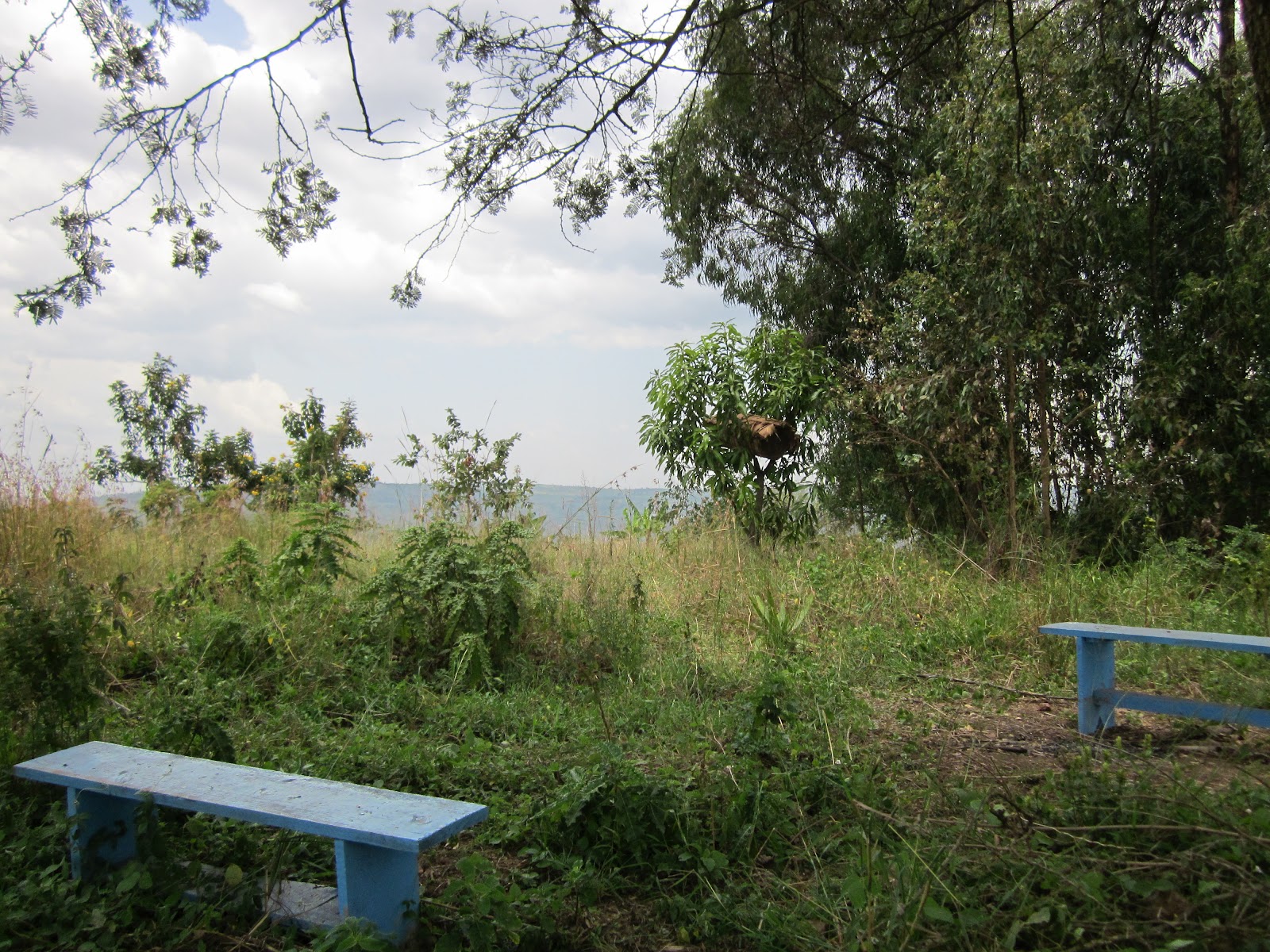
| Sitting area under the shade of an acacia tree and an Entada abyssinica tree |
Walking the Talk with the Environment Club
In the third term we are going to plant mango trees at all the family and staff houses. This initiative is to increase the products of ASYV, educate students and staff about planting trees as well as improving the environment of the village.
The Environment Club as Stewards of the Nature Park
The Nature Park in the Village has been a big part of the work of the Environment Club in 2012. (Please see
this post for the history, mission, and goals of the Nature Park.) In brief, the Nature Park is a lovely sanctuary for plants, trees, birds, insects and other critters on the hill above the school. It is a place of learning, a place of relaxation, a place to connect with nature.
 |
| The Environment Club creating a new walking trail inside the park |
2012 Vision
This year in the Nature Park the goal was to add, improve and maintain last year's achievements. So far this year, the Environment Club has:
- made new signs to direct visitors and ASYV staff/students to the Nature Park
- made a new walking trail, and start tree seeds to plant in the Nature Park
- cleared lantana (invasive species)
- planted a living fence around the Nature Park
- guided visitors on nature tours of the park
- researched trees and animals of the park to make interpretive signs
Currently there are two projects that are being completed in the Nature Park. One is to finish the interpretive signs for the park. The other is to make a meeting space using natural materials just outside the park. This meeting area is to encourage more students, staff and visitors to come to the Nature Park and teach a core team of students natural building skills along side with leadership, teamwork, and responsibility.
 |
| Natural Building in progress during Saturday Service |
A Field trip to Akagera
At the beginning of the year the Environment Club suggested to do a trip to
Akagera Park. Akagera Park is a 1200 km2 park that protects lakes, wetlands woodlands and savannah and many animals in eastern Rwanda. Due to budget constraints, the trip was cancelled. The Village has given me permission to fundraise for this trip directly to make it happen.
 |
| Planting trees for a living fence around the Nature Park |
Why?
The environment club is one of the hardest working clubs at ASYV. Most of these kids have never seen a hippo, a zebra, a monkey, a giraffe or even antelope before. These students have the potential to become guides, rangers, biologist and advocates of the environment in the future.
 |
| Planting trees for a living fence around the Nature Park |
"
You cannot protect the environment unless you empower people, you inform them, and you help them understand that these resources are their own. That they must protect them." Wangari Maathai
Give these students the opportunity to see what a rich diversity of flora and fauna Rwanda has. Give them the opportunity to understand that the parks , the air, the water, the forests of Rwanda are their own to protect.
The students can go to Akagera Park if I can raise $500 by October 8, 2012. This will allow 18 students to go to the park in two mini buses.
If I can raise $
800 by October 8, 2012, then this will allow us to go in 4 safari vehicles provided by
Intore Expeditions.
A special Thanks to Intore Expeditions who has graciously agreed to donate half the transport costs!
 |
| Tree planting in the Nature Park |


.JPG)