Saturday, September 29, 2012

Send the Environment Club to Akagera!

This year it has been my great privilege to work with the Environment Club.  There are 18 members of the club and they are all wonderful kids!  I want them to have the opportunity to go to Akagera in this last school term- and I want you to help me do it!

Clubs at ASYV
There are many different clubs in the village- technical club, newspaper club, sports club, IT club, language club.... etc.  The clubs are responsible for organizing different events in the village, education and suggesting ways to deal with problems in the village.

Environment Club Missions 2012

The students in the Environment Club decided on the following four main missions for 2012

  • Maintain the Environment at ASYV from pollution, bad air quality, erosion and other environmental risks.
  • To increase the products of ASYV such as fruit, flowers, medicine and timber.
  • Educate about the importance of the environment.
  • To protect and steward the Nature Park.

A glimpse into the Nature Park

Rwandan Youth and the Environment

We have had a wonderful year of work.  The Environment Club is made up of the two youngest grades with a couple of the older students to help. In the first term I focused on educating the kids about what the environment is and why it is important.  The older students already had a grasp on some environmental issues because of their exposure at ASYV but the younger students for the most part had never though about it.  The kids at this school are selected because they are vulnerable orphans. For most of their lives they have struggled to go to school, to get enough to eat, to have a safe place to stay.  So it is understandable that they have never thought about ecology, about climate change, about garbage, about clean water, clean air, about the role of living systems in their lives.  That being said- I am sure that environmental issues have touched their lives in: access to clean water, erosion causing crop loss and thus a lack of food, to having to walk a long way to collect firewood because of deforestation.


Maintaining the walking trail around the Nature Park

Education about Environmental Stewardship in the Village
In second term the environment club started to educate the other students about the environment. Specifically they were teaching their brothers and sisters how to take care of their gardens and to avoid throwing garbage everywhere.  Garbage is an issue everywhere in the world.  What to do with it? Where does it go?  This is the same in Rwanda- with one twist. In Canada we have anti-littering laws and education about littering. In Rwanda there is no such thing. When somebody opens a packaged item- gum, cookies, juice- they immediately just let the wrapper drop to the ground.  The number of times I have seen garbage thrown out a car or bus window is appalling. Most people do it, not  just the kids.  The only saving grace for Rwanda is that they have banned plastic bags (so one less thing to litter), and they clean all the time.  In other countries in East Africa the roads are lined with garbage.  At ASYV, the Environment Club is making a concious effort to education their peers and staff members about littering and trying to keep the village clean.
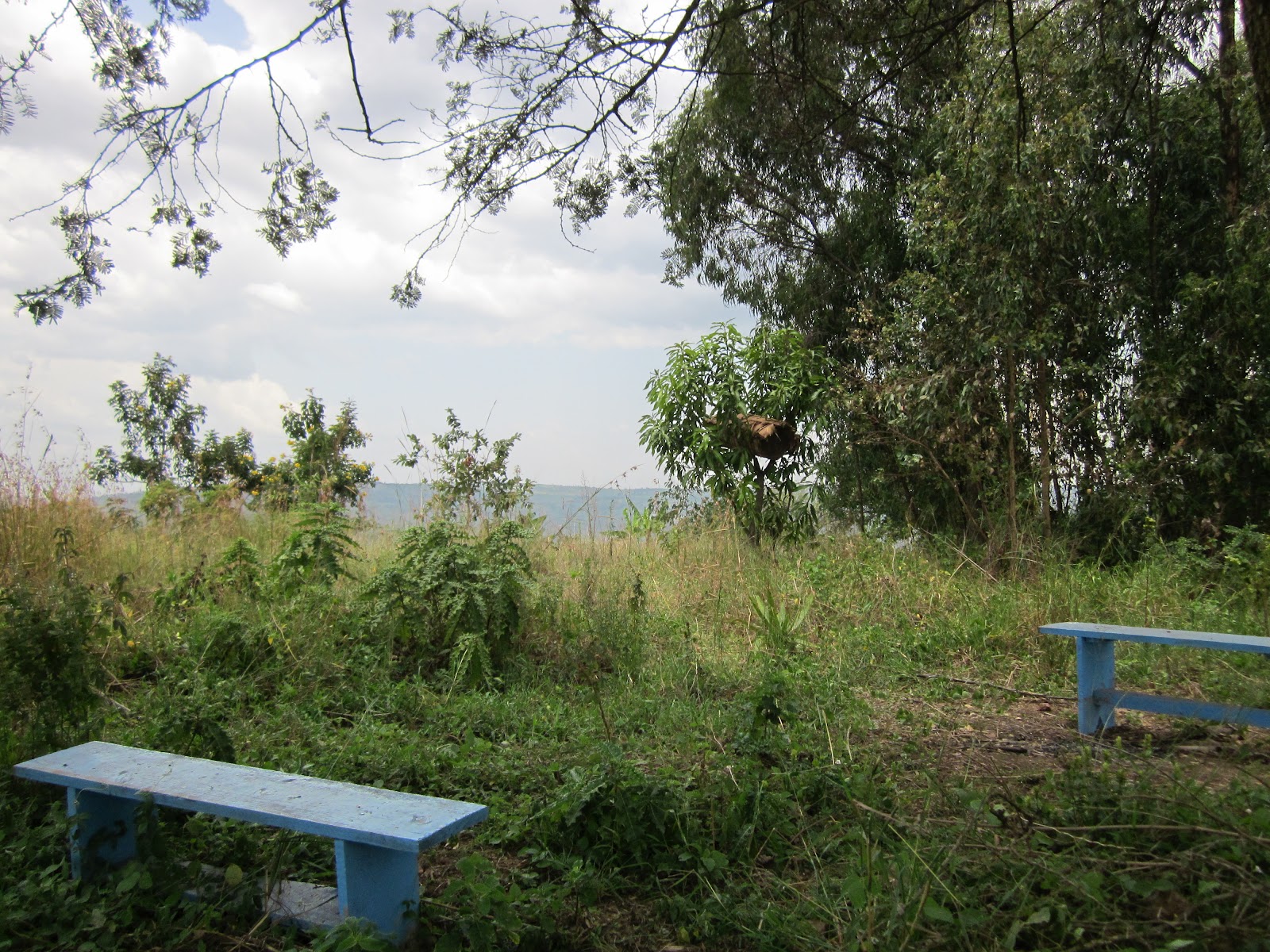
Sitting area under the shade of an acacia tree and an Entada abyssinica tree

Walking the Talk with the Environment Club
In the third term we are going to plant mango trees at all the family and staff houses.  This initiative is to increase the products of ASYV, educate students and staff about planting trees as well as improving the environment of the village.

The Environment Club as Stewards of the Nature Park

The Nature Park in the Village has been a big part of the work of the Environment Club in 2012.   (Please see this post for the history, mission, and goals of the Nature Park.)  In brief, the Nature Park is a lovely sanctuary for plants, trees, birds, insects and other critters on the hill above the school.  It is a place of learning, a place of relaxation, a place to connect with nature. 

The Environment Club creating a new walking trail inside the park
2012 Vision
This year in the Nature Park the goal was to add, improve and maintain last year's achievements.  So far this year, the Environment Club  has:

  •  made new signs to direct visitors and ASYV staff/students to the Nature Park
  • made a new walking trail, and start tree seeds to plant in the Nature Park
  • cleared lantana (invasive species)
  • planted a living fence around the Nature Park
  • guided visitors on nature tours of the park
  • researched trees and animals of the park to make interpretive signs
Currently there are two projects that are being completed in the Nature Park.  One is to finish the interpretive signs for the park.  The other is to make a meeting space using natural materials just outside the park.  This meeting area is to encourage more students, staff and visitors to come to the Nature Park and teach a core team of students natural building skills along side with leadership, teamwork, and responsibility.

Natural Building in progress during Saturday Service

A Field trip to Akagera
At the beginning of the year the Environment Club suggested to do a trip to Akagera Park.  Akagera Park is a 1200 km2 park that protects lakes, wetlands woodlands and savannah and many animals in eastern Rwanda.  Due to budget constraints, the trip was cancelled.  The Village has given me permission to fundraise for this trip directly to make it happen.

Planting trees for a living fence around the Nature Park

Why?
The environment club is one of the hardest working clubs at ASYV.  Most of these kids have never seen a hippo, a zebra, a monkey, a giraffe or even antelope before.  These students have the potential to become guides, rangers, biologist and advocates of the environment in the future. 
  
Planting trees for a living fence around the Nature Park

" You cannot protect the environment unless you empower people, you inform them, and you help them understand that these resources are their own.  That they must protect them." Wangari Maathai

Give these students the opportunity to see what a rich diversity of flora and fauna Rwanda has.  Give them the opportunity to understand that the parks , the air, the water, the forests of Rwanda are their own to protect.

The students can go to Akagera Park if I can raise $500 by October 8, 2012.  This will allow 18 students to go to the park in two mini buses.

If I can raise $800 by October 8, 2012, then this will allow us to go in 4 safari vehicles provided by Intore Expeditions.

A special Thanks to Intore Expeditions who has graciously agreed to donate half the transport costs!

Tree planting in the Nature Park


History of the Agahozo Shalom Nature Park

 Thank you to  Jared Cole, one of the 2011 long term volunteers (cousins), for the most of the information, vision, goals and history of the Nature Park.  He was important in starting the Nature Park initiative along with many staff and students at ASYV.

The History Nature Park
The ASYV Nature Park was formed in 2011 by over 300 ASYV students and staff.  All 24 families helped to make the park trail, remove lantanta, and/or plant trees over the course of May-October 2011 during Saturday Service events.  The Nature Park is 1.72 hectares (4.26 acres) and is 1558 to 1597 meters above sea level.   There are over 72 established native and fruit trees in the park, not included those planted in 2011-2012.  Around 90 species of birds have been observed in the Park as well as toads, skinks, striped mouse species, bats, mongoose and different types of insects.


Trail head sign at the Nature Park

Park Goals
  1. To provide a space for the Environment Club to explore, enjoy and educate others about the environment.
  2. To provide a space for students, staff, and volunteers to relax and enjoy the outdoors.
  3. To provide a training opportunity for skills in forestry, wildlife management, ecotourism, park management, and other fields.
Ecological Vision for the Park
In 10-20 years, the Nature Park should be mature enough so that cavity/tree nesting birds such as hornbills, woodpeckers, turacos, barbets, parrots will return to this area, to live in the Nature Park.  Not only would the local biodiversity benefit, but these are iconic birds that people tend to enjoy.    These species are also good indicators of ecosystem health. Their habitat is dominated by trees and these trees provide fruit and shade to people.  In order to accomplish this the park needs native trees similar to other remaining native forest areas, i.e. Akagera National Park Hills, Kibungo Valley and lower areas of Nyungwe.  These native trees need to be planted and they need to be protected so they grow to maturity.

A small Acacia tree growing. In several years this will provide a nice shady spot.

Social Vision for the Park
To get people involved.  If people enjoy the park, they will keep it .The park has many opportunities for learning (formally and informally), enjoying (art, relaxation, walks, eating fruits) and doing  Saturday service (clearing trail, removing lantana, caring for the trees).

" You cannot protect the environment unless you empower people, you inform them, and you help them understand that these resources are their own.  That they must protect them." Wangari Maathai


Park To Do (during Saturday Service or other times)
  • maintain trail so to prevent the park from being cultivated or grazed.  Unfortunately the fence was stolen in 2012 but a living fence was planted in September 2012.
  • Maintain native trees and fruit trees (and plant more where necessary)
  • Remove lantana
  • Make park accessible to people (sign, benches, trails).  Get people in it (to enjoy and help keep it as a community resource)

2012 Vision
This year in the Nature Park the goal was to add, improve and maintain last year's achievements.  So far this year, the Environment Club  with the help of 16 families have:
  • made new signs to direct visitors and ASYV staff/students to the Nature Park
  • made a new walking trail, and start tree seeds to plant in the Nature Park
  • cleared lantana (invasive species)
  • planted a living fence around the Nature Park
  • guided visitors on nature tours of the park
  • researched trees and animals of the park to make interpretive signs
Currently there are two projects that are being completed in the Nature Park.  One is to finish some interpretive signs for the park.  The other is to make a Natural Building meeting space just outside the park.  This meeting area is to encourage more students, staff and visitors to come to the Nature Park and teach a core team of students natural building skills along side with leadership, teamwork and responsibility.

Sewing bags filled with soil. One of the natural
building techniques we are using is called rammed earth or
earth bag construction.
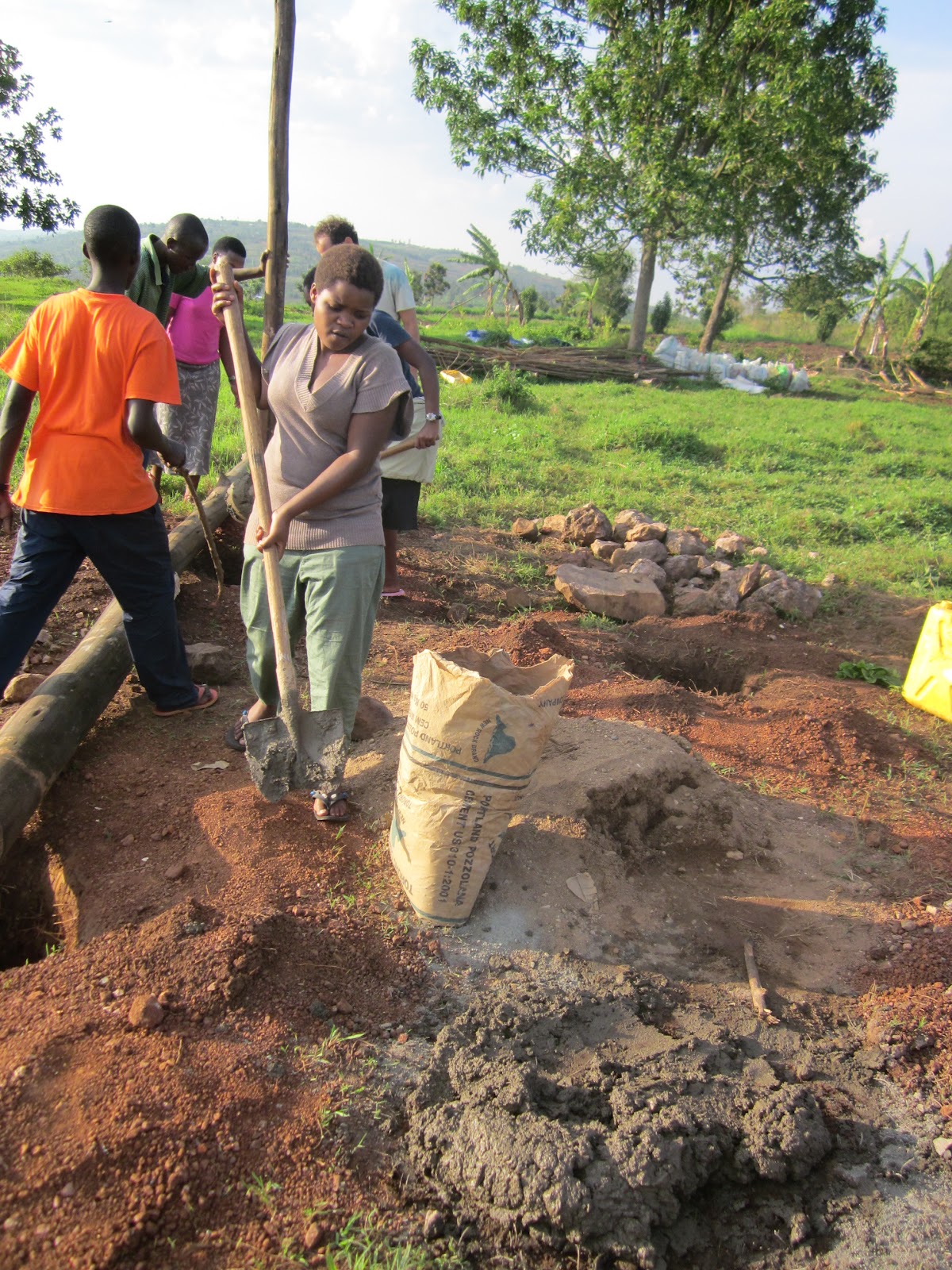
Mixing cement to hold the poles for the building secure.


Sunday, September 16, 2012

It's a Jolly Holiday....

 Here are the highlights from the 2nd vacation!

My parent's came to visit the village and we went together to see the gorrillas in Rwanda and also to Zanzibar.

My parents after seeing the gorillas
In Agahozo Shalom Youth Village, my Rwandan family was very happy to meet my parents!  My parents generously helped with my 'save the trees project'- which was to transplant all the viable tree seedlings from the nursery at the school to the nursery at the farm.  The school nursery was dry for about a month before my parents got there and the trees were looking very sad.  Some had even reached the permanent wilting point (ie dead). I'm working on a rain water catchment plan for the growing space up there so we will no longer be at the whim of the municipal water.

Tree nursery of acacia, eucalyptus, calliandra, greveilla
After very nicely helping me with my random projects around the village and getting acquainted with village life... we left for vacation!

First to the misty, cold(er) volcanoes of NW Rwanda.  Home of the mountain gorillas.
Silverback contemplating life

Then from there to Zanzibar.  Spice and beautiful beach isle!  wow!  It was so nice to swim in the ocean and to eat food with spices.  My parents left us in Zanzibar and we continued on our way overland (and a ferry) back to Rwanda.

Spices, white sandy beaches, clear ocean!
Most of our time was spent on buses but we did make one side trip to the Udzungwa Mountains.  We saw Mangabeys which are an endemic species of monkey from these parts.  We also met a biologist studying the shy, small, furry forest elephants.  It was a beautiful place to visit, and the streams were clear!  No mud water all thanks to the remaining forest cover on the Udzungwa Mountains.


Udzungwa Mountains

The rest of Tanzania was kind of meh.  We didn't do the northern safari circuit, maybe next time.  Although many people live on less than 1$ a day here, these are not the same people that go on safaris, or go to visit National Parks.  My Canadian sensibilities are insulted by exorbitant park fees, required guides, porters and all the ring-ga-ma-roll around visiting East African Parks.  But hey, this isn't Canada, where camping and hiking is cheap. I can't even imagine how much money goes into people climbing Kilimanjaro every year.  Where does this money go?  Back to the park? To the people?  I don't know.

The train should definitely be avoided.  You only take it twice: your first and last time.
The streets of Stone Town, Zanzibar

I know that some people love Tanzania, but compared to Rwanda, Uganda, and Kenya- the people were not helpful, wanted to rip you off most of the time, and were aggressive.  I was so happy to get back to Rwanda where people are nice, more honest and cleaner than Tanzania.  I wonder if this is cultural or if there is also a difference because of the emphasis on lowering corruption in Rwanda.  Tanzania gets many more tourists than Rwanda, but I'm not sure how much of the population actually benefits.

The rest of the time we spent at the village.  When we got back, they were just finishing off a theatre project with the International Theatre and Literacy Project.  The theatre piece that they made was amazing! (see last blog for photos).

And the village lived happily ever after...
We had a month of quiet (kind of in an eerie way), no water -except from the rain tanks, fast internet (well fast for the village) and different projects.  Jack installed a solar shower with some help.  Basically he put a black piece of pipe on the roof which gets hot in the sun. (Think of a garden hose on a hot day).  Our house keeps getting better and better, garden, mud oven and now solar shower!

Sun showers!

Tuesday, August 7, 2012

Genunine Progress Measures

I was inspired to write this after reading this blog by my Member of Parliment, Elizabeth May.  Elizabeth May is the leader of the Green Party of Canada and the first Green Party candidate to be elected in North America.  She is also the best MP I have ever had.  She is the role model of what every democratically elected MP should be.

Here blogs and tweets are informative. Her emphasis on democracy, free speech, integrity and cooperation are commendable. She represents the Canada I want to live in. 

Her blog was about the Genunine Progress Act, which is a way to measure quality of life instead of basing all our political decisions on GDP. 

Traditional Intore Dancers at Volcanoes National Park, Rwanda
 

She quotes the late Senator Robert Kennedy, who said just weeks before his death in 1968:

“Too much and too long, we have surrendered community excellence and community values in the mere accumulation of material things….The (GDP) counts air pollution and cigarette advertising and ambulances to clear our highways of carnage. Yet the gross national product does not allow for the health of our children, the quality of their education, or the joy of their play. It measures neither our wit nor our courage; neither our wisdom nor our learning; neither our compassion nor our devotion to our country. It measures everything, in short, except that which makes life worthwhile.”
 
How does this factor into Rwanda?  So often the speech in 'third world African countries' is about development. Africa needs development - in order to....what?  Feed it's people? have democratically held elections? provide clean drinking water? supply commodities to developed nations? provide a market for consumer goods?

Agricultural land just below Volcanoes National Park. The potato basket of Rwanda

Never mind that Africa is a continent, not a country. Africa has more than one story. 

And what does it mean to be third world? Is it as simple as taking GDP of a country as the indicator for the health of a country? Are the people actually poorer in the qualities that makes life worthwhile?
 
What do you see in the small children in dirty, ripped clothing playing on the road?   What do you see in man who pushes a bike full of pineapples 15km to the market?  What do you see in two old woman resting in the shade of an acacia tree while they wait for a bus?

Do you see only poverty... or can you also see the wit, courage, wisdom, learning, compassion, devotion... can you see that which makes life worthwhile?

I think Peter Godwin illustrates this perspective clearly in his book 'When the crocodile eats the sun' about his birth country Zimbabwe. 

"The cause of the cicadas' silence crests the path into sight; a ragged crocodile of small black children jogging back from school.  Joanna takes in their threadbare khaki uniforms and the striped jute book bags bouncing on bony shoulders, and I can see how it must look to her.  Even when they whoop and wave and flash bright-toothed smiles as they pass by, she sees ill-fitting, hand-me-down clothes and scuffed shoes or the bare feet of kids who walk miles to and from school each day and go home to thatched huts without indoor plumbing or electricity.  But what I see are functioning schools: pens and paper and a near-universal education producing Africa's most literate population.  She compares up, to the First World, where privileges are treated as rights.  I compare down, to the apocalyptic Africa that presses in around us, where rights are only for the privileged."

One side of the feuding families (asyv theater)
It is true that there are many problems related to poverty in Rwanda.  The fact that I am volunteering at a youth village for vulnerable orphaned youth is testimony to this.  There are problems with access to clean water, to schooling, to food, to health care, to housing.  Sometimes the stories I hear from the staff, the students, the farm workers, and villagers break my heart.  But there are also these problems in Canada and any other country  in the world. Perhaps the scale is just different.
 
But back to the original topic. GDP was developed to measure basic flows in the economy. (Next two quotes taken from The Pardee Papers, No. 4. Jan 2009, Beyond GDP: The Need for New Measures of Progress)

"The US Bureau of Economic Analysis’ description of GDP states the purpose of measuring GDP is to answer questions such as “how fast is the economy growing,” “what is the pattern of spending on goods and services,” “what percent of the increase in production is due to inflation,” and “how much of the income produced is being used for consumption as opposed to investment or savings” (McCulla and Smith 2007). "

 GDP was not meant to be an indicator for National Progress nor of well-being, but it is now used to compare quality of life in different countries.  More frightening is that: "Internationally, changes in a country’s GDP are used by both the IMF and the World Bank to guide policies and determine how and which projects are funded around the world."

There is at least one country that has refused to be pigeon-holed by its GDP. Bhutan measures its progress in not just economic growth, but also Gross National Happiness. 

"The concept (of GNH) implies that sustainable development should take a holistic approach towards notions of progress and give equal importance to non-economic aspects of wellbeing.... The nine domains are: psychological wellbeing, health, education, time use, cultural diversity and resilience, good governance, community vitality, ecological diversity and resilience, and living standards."

And wouldn't you be better off if your MP, your government were making policy decisions based on a wider range of indicators than just how much money you were making and how much you were consuming?

Dancing at the King's feast (asyv theater)

Many Rwandans struggle with poverty.  Many Canadians struggle with poverty.  Some Rwandans are very rich. Some Canadians are also very rich.  We are the same and different.  But one difference that strikes me is the access to education. While most Canadians attend good public schools up to grade 12, Rwandans have only to grade 9 and then they have to pay to go to high school. In addition, while I believe Canadian schools and teachers could have more funding, we are very well funded and developed compared to Rwanda.  The textbooks, the student-teacher ratio, the level of teaching and extra-curriculars are far different in Canada than in Rwanda. Where as highschool is a right in Canada, it is a privileged in Rwanda.

Rwanda will progress as a country but not necessarily through the penny counting of IMF loans, but through the resiliency and the cooperation of its people.  The GDP doesn't measure 18 years of continual work towards peace and reconciliation in this country.  It doesn't measure how Rwandans are trying to move forward to make some things right after the tragedy of the genocide.

The other day, the enrichment year students did a performance after a two week workshop led by the International Theater and Literacy Project.  The play was amazing (of course, but I am partial to these kids).  It was about reconciliation and peace.  Four of the characters in the play were orphans.  They were actually the heroes of the story because by working together, they brought back peace and restored order in the village that had been feuding.  They came together and although they were scared, and didn't think they could do it, one of them said something along these lines 'we are orphans but we are rich in mind. Together, we have the strength to do this.'


the orphans coming together to save the day (asyv theater)


Wednesday, June 6, 2012

World Environment Day

Yesterday was World Environment Day.  Every year the UN Environmental Programme chooses a new theme.  This year the topic is ' The Green Economy, Does it Include You?'.

Tuesday night is my time to program family time* so naturally, I thought to talk about the Environment on World Environment Day. 

*Family time happens 5 times a week for the Enrichment year students, usually from 9-10pm.  Usually they hear announcements, talk about their days, their challenges, tell stories, talk about the core values, or other topics like how to avoid getting pregnant, HIV etc.  On my night I usually bring a song to learn or a game because otherwise half of them sleep. (and who would blame them... they are up at 6 am and don't go to bed until after family time, and they are teenagers.)

Environment Club clear a new walking trail in the Nature Park


First we talked about 'what is the Environment?'.  Why is the Environment important?  What are the major problems facing the Environment?  Now, with the exception of of one of the girls in the ASYV Environment Club, I'm not sure if many of the girls had ever thought about forests, clean water, clean air, soil health, pollution, climate change in that way before. (or had even heard of those terms before)  Many of them knew about erosion (likely because this is the land of many hills, and many, many farms), and many knew that we needed oxygen to breathe.

Sometimes in discussions with the Enrichment year kids, it is difficult to know if they are actually ignorant of a subject, the subject is outside their personal experience, or if they are lacking English vocabulary for the new subject matter.  It may be a bit a combination of all of the above. 

For example, in school they have been doing sketches (skits, or theatrical performances) that they have written and performed.  Most of them are about orphans, teen pregnancy, HIV and sugar daddies.  Now, these are complicated subjects, but subjects that they have experienced (maybe not personally, but very closely), and have learned the English vocabulary for their sketches.  The performances are very good and you can see they they understand the topic very well.   Afterwards, there there are always questions for the performers.  Here, although they seem to understand the questions, their ability to articulate their opinions in a coherent manner (outside the practiced lines of the sketch) are a bit more difficult.  The answers end up sounding simplistic, even though you have just seen them perform a complex sketch.  But slowly, slowly... the language will come, the ability to put their thoughts into words will come.
Shady bench sitting area in the Nature Park

So, back to family time.  I guess I am saying that it is not surprising that we did not have a riveting discussion in English about the Environment for many reasons.  Which is why  I brought in some videos clips to help me explain.

Before they can understand the Green Economy, I wanted them to understand the business model where 'the Environment is your enemy'.  In order to gain, you must destroy.  This is the mentality with many extraction industries.

First I showed some clips from Manufactured Landscapes.  This movie  is about the work of   Edward Burtynsky, a famous Canadian landscape photographer. He doesn't take pictures of what inspired the Group of Seven, but of large scale industrial landscapes. 


Manufactured Landscapes is mostly about the large industrial manufacturing industries in China. What Edward Burtynsky is so gifted at capturing is the scale of these processes.  It will blow your mind.

So I showed them some clips from the e-waste part of the movie.  Over 50% of the world's e-waste goes to China, where it gets smashed and scavenged for metals that can be melted together to be sold again.  The only problem is that there are many toxic substances in the computers that are released in the process of breaking them apart to get at these metals.  In the movie, in one town, the toxins had run into the local aquifer so that they could no longer drink the water, and it had to be trucked in.

This also points out that Environmental problems are not just issues of middle class Americans, Canadians, Europeans that drive hybrid cars, carry a to-go cup, wear birkenstocks and wax poetically about hiking and eating organically. As with many things in the capitalist system, the Environmental and social impact of business does not get accounted for in the price of an item.   The problem is that because these costs don't show up in the price tag, the costs get socialized, and usually the are felt by the poorest people.  Hence, when you are using you smart phone, you get to benefit of updating your twitter account on the fly, while indentured laborers slave away in the Congo for the Coltan. When you buy a new computer and get rid of the old one, you are not the one who's water, soil and body gets poisoned by the e-waste, it is the poor people of China.  When you buy those non organic grapes from Chile, you may ingest some chemical residues, but the majority will be felt by poor farmers applying them and killing their soil.  While the oil companies make money off the tar sands, it is the Aboriginal people of Canada that feel the effect because they can no longer drink the water or fish in the Athabasca river.
African Tulip tree planted last year in the Nature Park

Then I showed them clips from Taking Root, a movie about Wangari Maathai.  The beginning of this movie illustrates the effects of how population increases and cultural changes towards the Environment were some of the causes of deforestation, desertification, erosion, loss of clean drinking water in Kenya.  This in particular, impacted (and still impacts) poor women because they generally fetch water and wood for cooking and had to go further and further to get it.  This is why Wangari Maathai started the Green Belt Movement, a movement to teach women to plant trees to reduce and reverse the social and Environmental impacts of deforestation.

This film I used because the images are close to their lives, their experiences, than say, a tribe in the Amazon rain forest.  Also it shows that Environmental destruction goes hand in hand with social effects.  It also shows a different model, maybe part of the Green Economy, where people are working with the environment, instead of against it to make their living.

Aloe in the Nautre Park
The last thing I showed them was the Earth Song clip from Michael Jackson's This Is It movie.  Although it is cheesy, the footage and song have very simple messages to understand.  Furthermore, Environmentalists get a bad rap for being downers all the time, so I wanted to end on something a little more up beat.  In addition, as these kids are teenagers, and worship what is cool, can sing every pop song on the radio, I thought I wouldn't hurt to cash in on MJ's famous pop star status to sell my Environmental message ( I mean, it is his message too, at least in that song).  MJ says in the film "The time has come, this is it. People always say, they'll take care of it, the government will... they will.... they who? it starts with us, it's us. Or it will never be done."

At the end, I asked if anyone had any questions or comments. I'm not sure how much of any of it they had understood or absorbed... but sometimes they surprise you.  One of my girls, who is also in the Environment Club asked:  "If people in America and Europe know that these industries cause pollution.  Why do they still build them?"

Good question indeed... Why?  The simple answer is greed and myopic decision making.  Maybe the Green Economy will become the new model....one where as Wangari Mathai says 'we are not digging our own grave'.  The UN Environment Programme defines the Green Economy as:

"one that results in improved human well-being and social equity, while significantly reducing environmental risks and ecological scarcities. In its simplest expression, a green economy can be thought of as one which is low carbon, resource efficient and socially inclusive."


Sunday, June 3, 2012

Gender in Rwanda

There are differences between girls and boys.  I'll give you that.  There are differences between people who like girls, people who like boys and people who like both sexes.  But do those differences have to translate into discrimination and differences in self worth or importance?

I don't claim to be a gender issue expert.  I'm not, nor am I particularly steeped in the politics or philosophical issues surrounding gender.  However, after being part of a women empowered, gender bending performance group for 5 years, I have picked up some sensitivities towards theses issues.  It would be hard to not pick up on these issues if you lived in East Vancouver for any length of time.

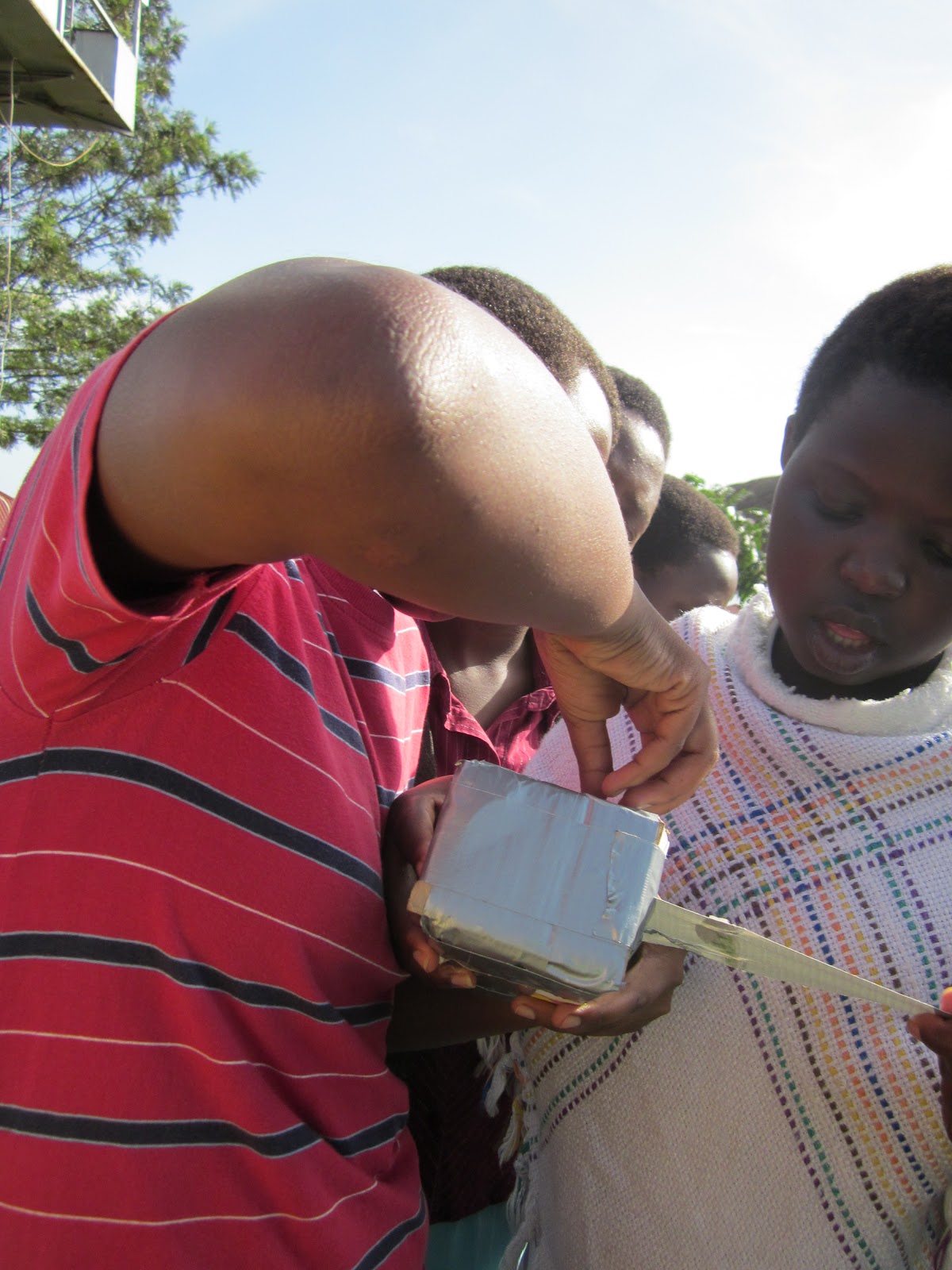
Target for ASYV Science Centre Egg Drop Competition
In Rwanda, it's different than Calgary, East Van, Cortes Island, Salt Spring Island, Kingston, Whistler, Pemberton, Portland, Seattle... In some ways for the better.  For example, Rwandan people are extremely affectionate.  Hand holding does not mean that you are boyfriend/girlfriend.  Cuddling and hand holding happen between any gender here.  You will see two grown men walking hand in hand or hugging each other on the streets here.  In North America, I'm not sure if many teenage boys have any physical interactions with their friends besides beating each other up.  This is partly due to the fact that being a teenager is awkward and you are always trying to be cool- and being a lone wolf in North America is somehow cool.

The other part is gender issues. Most teenagers are sexually insecure and raging with hormones.  In North American society where, except for some progressive schools, cities and communities, being gay is still not universally accepted.  In Canada we have gay marriage, but in the USA there are many, many States in which being gay is very scary. Even in Canada, I'm sure there are places where being gay can be very scary. That is why affection between same sex friends is not generally shown.

So what does this mean for Rwanda?  Well, unfortunately it does not mean that Rwandans have accepted gays and lesbians. A Rwandan told me that the whole point of being a successful Rwandan is to get married and have kids.  Being gay just is not an option. So hence why two girls or two boys holding hands is just being affectionate and friends.  I'm not sure if anyone here even thinks of the possibility of different sexual orientations.

Opening the egg box...
In many ways, the empowerment of women (feminism) and the empowerment of gays/lesbians is the same fight.  The fight to be free of gender roles, to be free to live and work in society with out judgment of discrimination because of their gender or sexual orientation.

What about Rwandan women? First of all, in Rwanda mamas are very well respected.  In the village, mama's word is the law.  Rwanda is very hierarchical, so generally they respect their elders (in some ways Rwanda feels like is has a caste system with differences in wealth and social power).  So whether the teenagers respect the mamas because they are their elders, or because they are amazing women, I'm not sure.

On the other hand, boys perform better in almost all subjects and sports than girls at ASYV.  I don't buy that boys are smarter than girls.  So either ASYV needs to improve its ability to empower the girls*, or Rwandan girls are socialized to have different attitudes/motivation than boys, or maybe a bit both.

* to be fair, ASYV takes in more girls than boys.  Although all students at ASYV are vulnerable orphaned youth, girls can be in more vulnerable situations than boys because of their physical stature and the risk of forced sexual violence.  In every grade there are  5 families of girls and 3 families of boys.

For example, we have been trying to have the first girls football (soccer) team at ASYV this year.  My co-coach and I are both feisty North American women who have a low tolerance for sexual discrimination.  We come from an experience that if you wanted to be on a good sports team in school or in clubs, you had to try out, work hard, and be committed.  Here, although a 2-3 are really committed, most of our team is absent and lazy.  Some could be really great players if they were committed.  The girls always have excuses like they are sick or they have a headache.  One or two I could believe, but 80% of the team, every week?  When they do come to practice, they sit down and complain when they have to run.

Opening the egg box....
When the boys team comes to practice after us, it's like night and day.  They all show up, they show up on time, they practice hard, they don't complain, they are eager to improve their skills.

In school it is the same thing.  Boys always participate in class conversations, whereas girls hardly talk.  Boys generally have better English skills than the girls (this could be a chicken and an egg issue). 

All the families choose names of heroes that they want their family to be named after. Out of 32 families, only 7 are women.  When we were in the process of choosing the name for our family, I asked why they didn't want to choose a woman.  The girls said 'we don't want to be the girls of a woman'.... as if this would be a great insult.  Granted, some have psychological issues with their moms who maybe they never knew, abandoned them or were negligent... but still to have such a strong hate on for women?  Where does this come from?
 
So what gives Rwanda?  To have such strong, respected mamas, such open affection between people and yet I feel like the girls are falling behind in every way.  Maybe ASYV is a place for them to be safe, heal and learn for four years and then they will go on to get married and become awesome mamas.  That is great.  I fully support that.  Because people that are healthy and whole will do more for the society than vulnerable, hurt and broken people.

The only thing is, their words betray them. If you ask them what they want to do after ASYV they will say I want to be a business woman, a doctor, go to university, work at a bank, be a journalist, be a lawyer etc.  But where is your motivation today to get you there?  They have a maxim here that says ' if you see far you will go far'.  Where are you going girls of ASYV? And how are you going to get there?

Success!!
*Disclaimer- there are also some really, really, really amazing girls at ASYV that are motivated, strong and smart.  And all girls at ASYV are special and fantastic in their own way.  This blog is how I see gender in general in Rwanda, and in ASYV on a more general level.

Friday, May 11, 2012

East African Botanical Resources are you out there?

As a plant nerd- I love learning about new plants, their uses, their ecologies, their cultural link to the people that know, use or love them.  I have been looking for resources to know about more plants in Rwanda and the surrounding area and so far have come up with little.  I have been asking local people about the plants, their names, their uses and such but I have yet to find a plant nerd that I can communicate with, that is willing to share some of that knowledge.
The stems of this shrub are hollow and were traditional used for straws

Last week I went on a field trip to different nurseries with one of the staff members.  We were looking into types of trees and prices for the village.  (The village also has a nursery, but doesn't have all the species I was looking for.  If the village wanted to, I'm sure they could make quite a business by collecting seeds, planting them and propagating trees.)  

So any way, we going all around Kigali and the outskirts to look for trees  with me towing along, communicating in Frenglish....yes that elusive language I learned as a French immersion kid comes in handy.... no actually, I was communicating both in English and in French because the person I was with is somehow difficult to communicate with, although excellent with plants.  That's how the day went, lost in translation mime acts along with writing down the names and prices of trees so I can submit a budget for the environment club.

Now, here I am at my computer with a somewhat illegible notebook of names of trees and plants that are in Latin, French, English and Kinyarwanda.  Especially for the ones in Kinyarwanda I am trying to rack my memory for what my co-worker said they were- or if he did.  So to the nets... collectively there must be something to help me out there.

First I try this website http://kinyarwanda.net  This website is the best tool on the net for help with the Kinyarwanda language.  Amazing.... but no luck with Umusebeya

So I put it into google and miraculously somebody has made a one line wikipedia article in Kinyarwanda about Umusebeya.  To top that off, there are latin names in that article.  Oh yes!!  Botany Gold!!   Latin names are the special password in internet searches about plants.... if you put in a common name you are more likely to get fluff, or not very helpful articles.

So here you go- Umusebeya could be Albizia adianthifolia or Albizia gummifera.  These trees are native tree species of Africa, and Rwanda are in their range.  They have large, flat toped canopies, which are excellent for shade (which the village desperately needs).  They also have flowers that attract beneficial pollinators and are important for certain species of butterflies.  They are associated with nitrogen fixing bacteria so they grow quickly, have good timber.  These species have also traditionally been used to treat many different kinds of illnesses.

For more information on these trees:
Albizia adianthifolia
 Albizia adianthifolia
 Albizia gummifera
Albizia gummifera

Also a another resource that has been helpful courtsey of google 'owns the universe' books is A Field Guide to Common Trees and Shrubs of East Africa

 Happy Botanizing!