Friday, April 20, 2012

Happy Travels

The end of term here was very busy and I seem to have developed an allergy to my computer.  Farmer's are not known for their love of technology, some are pretty much techno-phobes.  I'm not sure what the problem is... slow internet, so many other things to do, writers block, but when I look at the computer I say 'achoo' I don't want to go near that thing!

However, we have just spent two weeks in Uganda and Kenya.  So here is a bit of a photo essay of the experience.
Byoona Amarga, Lake Bunyoni, Uganda. solar powered, composting toilets, library, good food,  lake side setting of tranquility!  I would head back there if Uganda visas weren't such a rip off!
 
Hell's Gate National Park, Kenya.  Maybe the only park in East Africa where you don't have to be in a truck while watching animals.  Rent bikes or walk on a DIY safari!

 
Notice Jack meandering quietly beside the African Buffalo- while I booted my way past them...I think I would take a bear over a buffalo any day.  They seem little unpredictable and daft in a dangerous way.  And they give a mean stink eye.


Zebras!  They make crazy alien/dog noises. for real.  Also Hell's gate has some sweet camping on the rocks above all the plains where the animals are grazing.


One of the most inspiring parts of the trip was visiting JB on his farm Balitah Ravens Farm in Butula District, Kenya.  This man is a permaculture evangelist! No really- preacher turned permaculturalist.
JB and part of his family

I was connected to him by Salt Spring's Michael Nichols of Seven Ravens Farm. Both Michael and JB have been doing permaculture work in primary schools in the area. The permaculture projects are to develop food, shade, timber, trees, funds and training for these primary schools.  They are amazing projects.  I plan to write a more in depth blog post on them soon.
Fish pond at Bukati Primary school with a forest around it to create a cooler microclimate.  Rain water is harvested to feed this pond and the fish are harvested to feed the children.

The visit with JB really got a kick in my rear end to bring permaculture to Rwanda.  It's happening in Kenya- why not Rwanda, why not ASYV?  It seems like I will have to work hard to 'sensitize' the farm staff and admin to this idea. (Sensitization is a special East African English word which means to tell someone about an idea or a plan.  Sensitization can be very frustration to someone of North American culture because they ask: 'why do we have to talk about this so much?  can't we just do it?'  But you can't do anything here without sensitization.)

JB and students working on the permaculture project at Buduma Primary School, Kenya
The programmer who planted trees
Needless to say when I got back to ASYV this week I have been working hard at my garden around my house. I was happy to see that the rains in Rwanda over the two weeks we were away made the garden grow very well. This is a little organic garden/permaculture seed that I hope will start spreading around the village.  The farm at ASYV has many directors- but the little garden around the house is basically my domain. I have been planting delicious food, fruit trees (I hope you will enjoy future volunteers), composting, water harvesting, etc.  I have been thinking about how best to insert more of these little projects around the farm... maybe the easiest thing is to start digging swales and making rain water harvesting and contouring an actuality at ASYV.  Since the water system here is unreliable for agriculture it would be perfect.  As some permaculturalists say 'the problem is the solution'.

Giraffe!  They look like they should be walking around with dinosaurs.

Sunday, March 4, 2012

The sound of silence

I the deep dark winter in Canada, in the temple of the Rocky Mountains,  the snow blankets the landscape with glittering whiteness under the sunny blue skies.  The air is thin and sharp with cold and yet imbued with a hint of spruce, hemlock and fir. Green-black evergreen branches sag with the heavy load of snow.  Life is still.  Life waits for the the return of spring.  If you listen closely you hear an insulated silence unlike anything else I've found.  This is the sound of a quiet mind, of peace. 

On another continent- in the eastern province of Rwanda, the sound of an airplane overhead disturbs my musings.  In urban North America you hardly even notice because it happens quite frequently.  But here- the white noise of machinery has not dulled the sound of the birds, the crickets, the frogs. 

In some ways it is not quiet at all- there are 500 teenage students plus staff talking, yelling, laughing.  There are radios blaring top Rwandan and American pop music while they are outside doing laundry, or hanging out.  There are people around most of the time.

People enjoying the 1st part of a Rwandan Wedding
ASYV is located in a rural location, about 7 km off the main road, there is really not much motor vehicle traffic here.  There are lots of people walking.  Even small children- there are no such thing as strollers here.  Mamas carry their babies wrapped in a cloth on their backs for about the first 1-2 years.  As soon as those babies can walk, they do.   It's not uncommon to see children of all ages carrying firewood, water, or other household necessities. There are bicycles going by carrying people and incredible loads of pineapples, plantains, people, water, fanta, banana beer, lumber...you name it!

As for motor vehicle traffic- most of it on our rural road is moto traffic.  They transport people and goods quickly and relatively cheaply... although not as cheap was walking, biking or bike taxi.  Then there are transport trucks that carry usually plantains from this area to larger markets.  Occasionally there are van taxis that come down this road- but not very often.  And then there are also some personal vehicles-  but these are still not very common in Rwanda.  Most personal vehicles belong to the rich or middle class in Rwanda.

Rwandan wedding introduction
At ASYV, the property is surrounded by a fence and all traffic goes through the security gate.  So even less traffic comes into the village.  On weekdays there is 15 passenger van and a bus that take staff and teachers from Kigali and back.  Then the higher up managers and directors have their own personal vehicles.  But most staff and students walk in the actual village.  Apart from the tractor and a couple pick up trucks for moving big items- there is very limited traffic.

some of the bike parking at the wedding
Now for those who will argue about the benefits of motor vehicles in our modern day, and the accessibility they grant to the less mobile, the elderly etc....I acknowledge that motor vehicles make life alot easier for those who have them.  It's not easy pushing a loaded bike a long way to market everyday.  But at what cost?  And who bears the costs? 

But this post is not about the politics of oil, cars, alternative transportation....even though I have thoughts about all these subjects. And I encourage you to get involved with any of these topics- especially in Canada right now. .....

This post is about sound.


At night you hear the crickets.  In the morning you are awoken by the birds.  Everywhere in between there are the sounds of people talking, singing, drumming, hoeing, cutting the grass the machetes, radios and cell phone ring tones.  It is not silence- but the sounds of life vibrate intensely here.


I have lots of friends that fight every day to create opportunities for quieter, safer streets for people to live in.   Next time you are going a short distance (I know it is still winter in North America) to pick up some bread, going the mail box, renting a video...think about taking a walk, a bike or a bus.... and listen to the difference it makes in your local streets.


Thursday, February 23, 2012

God sleeps in Rwanda


In our staff training before the students came, we heard many Rwandan proverbs or stories.  In the old times, before the colonizers came to Rwanda, the people here used to say that while God might go and visit other places and people in the world during the day- God always came back to sleep in Rwanda at night.

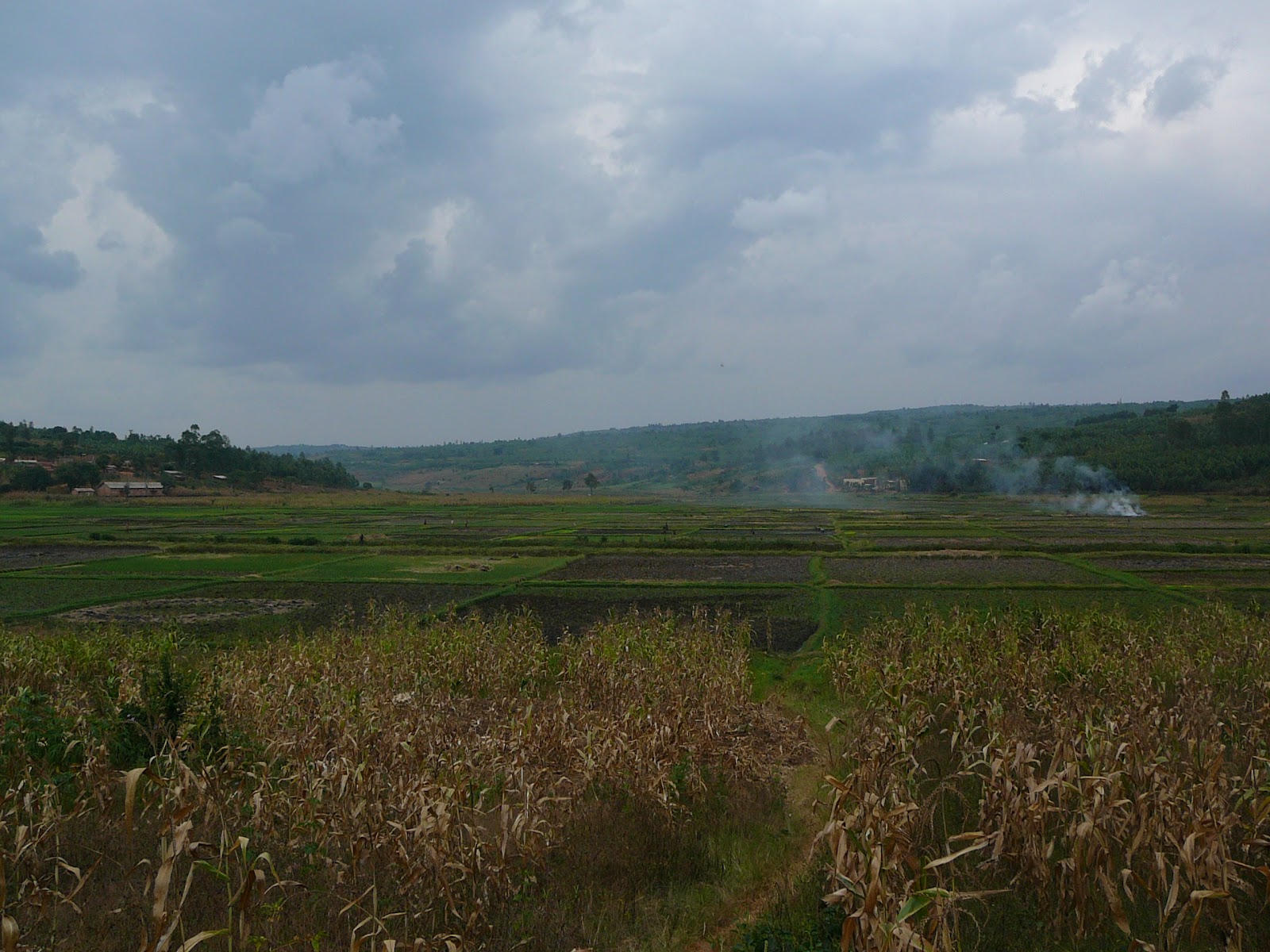
Rice paddies near Rubona
Today- God not only sleeps here but is very involved in day to day life.  When I help a student with their homework- some of them say 'thank you, god bless you.' Church activities define the weekend here- what religious group is praying where and when.

 Although the village is not religious institution, I would say that 99% of the students and staff here believe in God.  I would say this is also true of Rwanda.  Most Rwandans are some form of Christianity with a minority of Muslims. This month there has also been a group of young Jewish students here on a gap year between highschool and university.  They have their own traditions and religious activities to add to the mix.  Most of the incoming Rwandan students have never heard of Judaism before- so it is interesting to see the Jewish students and the Rwandan students talking together about faith and Religion.


Atheism, Agnosticism, Buddhism, Hinduism, Shamanism or any other faith (or lack of faith) is not known here.

So why is it, that Rwandans' are so hopeful, so faithful?  It seems proposterous when you consider the country's history... or does it?  We all need something or someone to believe in.... something to hope for.  I think that Rwanda has many reasons to be hopeful and to believe in the future.

Lake Mugesera
Sufi poem atributed to Hazrat Inayat Khan

“ I asked for strength
and God gave me difficulties to make me strong
I asked for wisdom
and God gave me problems to learn to solve.
I asked for prosperity
and God gave me a brain and brawn to work.
I asked fro courage
and God gave me dangers to overcome.
I asked for love
and God gave me people to help.
I asked for favours
and God gave me opportunities.
I received nothing I wanted.
I received everything I needed.”

Saturday, February 11, 2012

Questions and Answers???

I cannot believe it has been a month since my last posting... ahh sorry. 

Alot has happened in the last month and I wish I had a Jhumpa Lahiri's skills at digesting small details to make a whole picture in an interesting way.  I'll try to do my best.

So I've been struggling with alot of different issues lately.  Nobody ever said coming to Rwanda to work with orphaned youth would be easy.  If you have ever seen the documentary 'Schooling the World'(I would highly recommend it!), you might even think that my presence here is exactly the opposite of helping.  Am I just another neo-colonialist? What kind of unattended consequences am I having here simply because I am a foreigner?


ASYV Traditional Rwandan Dance Troupe- performing in the Amphitheater
My struggles apart from the usual (I ask myself the same questions in any occupation in Canada): what am I doing here?  Is this the right thing to be doing?.... are mostly philosophical issues pertaining to the environment and farming,


I am helping with the Environment Club here and I have been trying to explain about what the environment is- why we need it, how we are a part of it etc.  However, environmentalism is a foreign concept here, especially for kids who have struggled all their lives to have their basic needs fulfilled.

For example- when I asked 'why are trees important?' I got some really great answers like: trees produce oxygen, they help with global warming, they attract rainfall, but I also got some interesting answers like they attract tourists, or they are decoration when they are planted in a line.

Also with the exception of three national parks, there are very few 'wild' places in Rwanda.  There is lots of greenery- but mostly from tons of bananas.  Like I said before- this place is one big garden.  Which is not to say gardens are not nature... let's just say there is limited habitat for wild plants and animals who do not thrive in garden type environments.


Bananas in the valley.  The top of the hill is ASYV.
The question is- do humans have an innate understanding of nature and their connection to the earth?  Can a kid from the slums of Nairobi who has lived in a landfill all their life understand nature? 
 

“You cannot protect the environment unless you empower people, you inform them, and you help them understand that these resources are their own, that they must protect them.” Wangari Maathai

One of the other challenges is that the kids think that all development is good.  Money is good, jobs are good, cities are good- it is all good.  Jack told his family about Vandana Shiva- and her battle to fight large corporations who were trying to take away the freedom of farmers by selling them GMO seeds.  They had difficulty understanding that someone who was trying to bring in money and western ideas could be bad- or at least not have the best interests of the farmer in mind.


Which leads me to another sad observation.  People everywhere want suburbia.  They want to live in a big house and have a car and be fenced off.  They can live with their families and watch TVs and drive their car wherever they go.  This is very much the predominant changing landscape of Kigali.  Goodbye small houses, goodbye poor people- make way for suburbia.  It's frightening.  Suburbia doesn't work in North America- it makes people, fat, isolated, and dependent on fossil fuels.  It is empty.  Does the rest of the world need to follow in North America's footsteps only to learn the same thing 20 to 30 years down the line?
 

"I am increasingly sensing that the primary threat to nature and people today comes from centralising and monopolising power and control which inevitably generates one-dimensional structures and what I have called "Monoculture of the Mind". The monoculture of the mind treats all diversity as disease, and creates coercive structures to model this biologically and culturally diverse world of ours on the privileged categories and concepts of one class, one race and one gender of a single species."  Vandana Shiva


Local swimming hole at lake Mugesara
Also I am struggling with some different ideas of agriculture here at ASYV.  Some ideas that are pretty much the opposite of permaculture.


It seems like everywhere I go, my perspective, my ethics, my sensitivity towards earth care leads me into these conflicts with the big machine of money and development.  Sometimes I think that it would be so much easier if I just consumed like a normal person and didn't question the trajectory so much.


However- that is not going to happen.  One of my yoga teachers says that a yogi is trying to line up their thoughts, words and actions.  You know you are making progress in your yoga practice when you 'say what you mean, and mean what you say' (which is on another note- is my New Year's resolution). 

Wetland at lake Mugesara.  Looking away from the lake towards ASYV.

Many people inspire me- but two that I have bee thinking about lately (because of Rwanda's National Hero's day) are Vandana Shiva and Wangari Muta Maathai.  Both are outstanding women who have fought for women's rights, the environment and against big business/big governments. How do I become like them?  How do I tell the story of complex, living systems to the 'monoculture of the mind'?


“Every person who has ever achieved anything has been knocked down many times. But all of them picked themselves up and kept going, and that is what I have always tried to do.” Wangari Maathai

Friday, January 20, 2012

Pictures of the farm

Ibishimbo- Dried beans lined up to dry

Threshing the beans, blowing off the chaff

Bees!

Thursday, January 19, 2012

Growing food in Rwanda

It's hard to believe that we are now into the second week of school. It's true what they say- the days are long here, but the weeks and months race on. Now that the students are in school from 7am to 2pm, I have a bit more time to explore the farm. 

The farm has chickens, cows, bananas, avocados, guavas, citrus, pineapples, kidney beans, maize, coffee, sweet potatoes, tomatoes, peppers, eggplant and more.  It is relatively young, although I'm sure most of this land has been under cultivation at one point or another by previous owners.  Except for a few trees, most fruit trees or on the farm were planted 3 years ago, and some are just beginning to give fruit.

ASYV is physically located in a warmer and drier area of the country.  The area of the village which is not landscaped with grass, hedges and trees, or farmed,  is covered with bushes.  Very few mature trees exist on the land either because it has been cultivated for such a long time, and/or the trees were cut down for fire wood over the years.

In Rwanda, most people use firewood or charcoal to cook.  Given the amount of people and the little land that is still forested...this is quite worrisome. In addition, many people plant Eucalyptus trees here because they are extremely fast growing.  Eucalyptus are very good at sucking up water and nutrients from the soil and doesn't allow for other plants to create an understory.  I think Eucalyptus might have a role as managed pioneer species in combination with native trees or other desirable fruit/nut/forage species, but a pure stand of Eucalyptus does not favour biodiversity.

ASYV has planted trees in the main part of the village and also in an area called the nature park.  This will be wonderful when the tree grow, and hopefully more trees we be planted specifically for shade purposes.  This will moderate the temperature in the village, build the soil, buffer the wind, and create a more enjoyable micro climate.   Depending on the species selected, they may also produce food, forage, mulch, and medicine.  (Especially if this permaculturalist has anything to do with it!:))

The nature park is an area behind the school that some of the past volunteers, staff and students helped to map, plant trees and build trails. This is a place to explore, relax and learn. This is an area that is unlike most of Rwanda.  Natural spaces are few are far in between.


Riding in the bus around Rwanda, you get the sense that the whole country is like one big food garden (with smatterings of the hedges and lawns aesthetic). Bananas, potatoes, corn, sweet potatoes, beans, peas, and cows are everywhere you look. Crops are farmed right up to the road and on incredibly steep hills. If I were skiing some of those hills- they would be double black or black diamond steep. However, I suppose that is what is needed for a country of 11 million people. Lots of food.

The traditional way of subsistence farming seems to involve polycultures of different plants all growing together. However, the plants that they grow (bananas, corn, beans, potatoes) are the same all throughout the country. I wonder how much plant diversity there actually is in the country- and what would happen if a fungus or virus came through for one of those staple plants. I hope there are many different varieties of those staple plants so that if something happens, there is some resiliency.

Something else that worries me is some of Rwanda's agriculture policies.  They want to aggregate farm land so they can grow one crop and it will be easier to mechanize.  Sounds like a familiar Western practice which I don't think has actually benefited any farmers (ask the farmers in the corn belt of the USA)... maybe these policies benefit the pockets of large agribusiness, but farmers... that is questionable. (The Omnivore's Dilemma by Michael Pollan illustrates this very well)

Although this policy this might make planting and processing more efficient, I'm not sure if it will produce more food. Furthermore, if mechanization is involved- might actually hurt the long term sustainability of the soil.  Steep hills and tractors or rotatillers= soil loss, erosion for sure!  Also it sounds like aggregating farm land would reduce farmer's agency in deciding what they want to plant.  It would make them plant cash crops which are at the whims of international price markets and not allow them to grow food for their families first.  Although I am sure there are lots of ways to improve smallholder production, I am not sure about this policy... (more about this and other policies later).

On a lighter, and less controversial note, I started helping out on the farm this week.  There are about 20 farm workers from the surrounding community.  Most of them have been farming all their lives... so they think I am quite comical because a) I am a westerner and b) because I don't have their same level of dexterity and skill with the farm tools.  One day they gave me a giant stick to use as a pry, and a machete to cut down bushes (to mulch the bananas).  I could not for the life of me figure out how to wield the stick and the machete with any sense of efficiency- even though I had plenty of good role models.
Another day, when I helped to beat the beans (to release the dry beans from their pods), I apparently had the wrong technique, even though I thought I was doing it exactly the same as everyone else.  So I certainly have a long way to go to being awesome with the local tools and techniques, but it is a good way to build relationships and observe the farm.  After all, the first principle of permaculture is 'to observe and interact'.
 
If anyone out there has some ideas of of wonderful permaculture all-star plants that can be grown here to add diversity, resiliency, habitat and an income for the people of Rwanda. I am interested in learning about these plants, finding them and planting them.

Sunday, January 8, 2012

Pop Culture Fail

For the last week all of the cousins, with help from four ESL teachers from Canada and the States, have been teaching English to the new students.  Between all the lesson planning, teaching, meetings and other responsibilities there has been very little room to breathe. However, the teaching has been pretty fun and a good way to get to know some of the kids outside your core family group.

One of the most challenging parts of teaching this week was to get the girls to talk and participate. In general, the Rwandan girls that have arrived for the first time at the Village are soft spoken, demure and shy.  When you ask them their name you can barely hear them reply.  This is also true of some of the boys, but they are generally a bit more outspoken and willing to speak in  English. It is difficult as a teacher to gage if they understand or not if there is no feedback.  Gradually over the week, my co-teacher and I managed to coax them little by little out of their shells so that we could actually have some decent conversations, games, presentations and exercises.

This is also true of the girls in my family. As they have been getting to know their sisters, they turn into chatty, giggly teenage girls.  Which is great, because I have actually been able to have a some fun conversations with them.  All the students are curious, but the questions I get the most are: 'Do you have parents?' and 'Do you have children? or How many children do you have?'.

The first is one that you would not typically get in a North American context.  It is more like 'Are your parents still together, What are there names, What do they do?'  something like that.  In Rwanda, and especially with these kids- who are mostly orphans, having parents (that are still alive, or that they know) is a rareity rather than the norm.  It's startling.  I expected when I came to Africa to feel some sense of having been born into extraordinary riches- merely by the fact that I come from Canada, a generally peaceful country with good education and health care.  I did not expect to feel rich or lucky for the fact that I have parents that have cared for me and taught me all my life.  Although, if I really examine the idea of having parents, it is probably one of the best things you can have in your life- loving parents.  When I say I have two parents, they kids look at me like I have won the lottery.

The second question is also not super typical in a western context to someone in their late twenties.  Part of it is that Canada does not have a very high birth rate compared to Rwanda, and also many Canadian women now have their first child from late twenties to mid thirties.   It also seems funny because there is no question of having or not having children in their minds- just how many.  Mostly my answer is: "I have no children, because otherwise I could not be in Rwanda at the Village with you for a year."

My favourite question so far has been (with a very serious face) 'Melissa, Do vampires exist?'  I had a whole bunch of very interesting question that night about conspiracy of the pyramid sign on the American dollar, mummies and Rambo movies... as if they had been saving all the questions they had ever wanted to ask a westerner.  Amazing!


The other questions I've been asked recently have been 'Melissa, tell us about Drake, Rhiannon, Shakira, Justin Bieber etc etc'.  Now for those of you who know me- know that I am more of an eccentric type of music listener than the mainstream.  (with exceptions of course!)  Some of you might recall a story about a time when I met Swollen Members (a somewhat popular rap/rock band in Canada) and told them I had no idea who they were- and didn't listen to commercial radio.  (harsh, I know).

So I told my girls the little that I knew about Justin Bieber and the likes, but it wasn't very much.  I said, I know about Michael Jackson and Bob Marley, and their response was 'they are both dead'.  i.e  Melissa, you are old- and listen to old music, get with the program.  (On a side note, I did play some Bob Marley in English class to learn some lyrics and some of the boys LOVED it!)

That's all for now- I've got to go study up on pop culture before my girls grill me again :)